
A fridge that runs on 700 watts may need up to 2,200 watts just to start.
That gap comes from EcoFlow’s published appliance chart, and it’s why running watts vs starting watts trips up so many generator buyers.
Below, you’ll see what each rating means, which appliances surge, and a 4-step way to size a generator for both.
Running Watts vs Starting Watts: What Each Number Means
Running watts are the steady power an appliance draws, or a generator can supply, for as long as it’s on. Starting watts are the short burst above that a motor needs for a few seconds to get moving.
You’ll also see starting watts called surge watts or peak watts. Same idea, different label.
Why the jump? An electric motor at rest pulls a rush of inrush current until it spins up, then settles back to its running draw.
So every generator has two limits: what it can hold for hours, and what it can hit for a moment.
Which Appliances Need Extra Starting Watts
Appliances with an electric motor or compressor need extra starting watts, such as refrigerators, washers, dryers, pumps and air conditioners. Heat-only appliances such as space heaters and toasters start at their running wattage.
Power-station maker EcoFlow’s own chart, published in July 2025, shows how wide that gap gets:
| Appliance | Running watts | Starting watts |
|---|---|---|
| Refrigerator/freezer | 700 | 2,200 |
| Washing machine | 1,200 | 2,300 |
| Electric dryer | 5,400 | 7,000 |
| Space heater | 2,000 | 0 |
The fridge needs more than 3 times its running figure to start, while the heater needs nothing extra.
Your own unit can sit higher or lower, so sizing for a fridge, a well pump or central air conditioning starts with its label.
How to Calculate Running and Starting Watts for a Generator
To calculate generator watts, add the running watts of everything you’ll run at the same time, then add the largest single starting surge. The generator’s running rating must beat the first number, and its starting rating must beat the second.
Here’s how it works:
- List what runs together. Not the whole house, just what’s on at once.
- Add the running watts. That total must fit under the running rating.
- Find the biggest surge. For each motor, subtract running watts from starting watts.
- Add the largest extra to the running total. That peak must fit under the starting rating.
You only add one surge because you’ll switch motors on one at a time.
Say you want a fridge, a washing machine and a space heater, using the chart above.
Running watts: 700 + 1,200 + 2,000 = 3,900. The fridge adds the biggest extra (2,200 - 700 = 1,500), so your peak is 5,400 watts.
Notice the fridge sets the peak, even though the washer has the bigger starting number.
Longer lists work the same way, and the generator load calculation formula keeps the math straight for a dozen items.
How to Read Starting Watts on a Generator Spec Sheet
A generator spec sheet lists two ratings, running (or rated) watts and starting (or peak) watts. The running figure tells you what the generator can power for hours.
So check which number the model name uses. A big number on the box can be the peak rating.
Three other details change what a rating gives you:
- Outlets: a 30 amp or 50 amp connection limits power to your home.
- Units: some standby spec sheets list kW vs kVA instead of watts.
- Altitude: engines make less power up high, so derate for altitude.
Starting Watts on Portable Power Stations
Portable power stations handle starting watts with a short surge mode, and that surge doesn’t raise what they can run continuously.
For example, EcoFlow says its DELTA Pro is rated for 3,600 running watts, raised to 4,500W with its X-Boost feature. The same company notes X-Boost doesn’t increase the rated AC output.
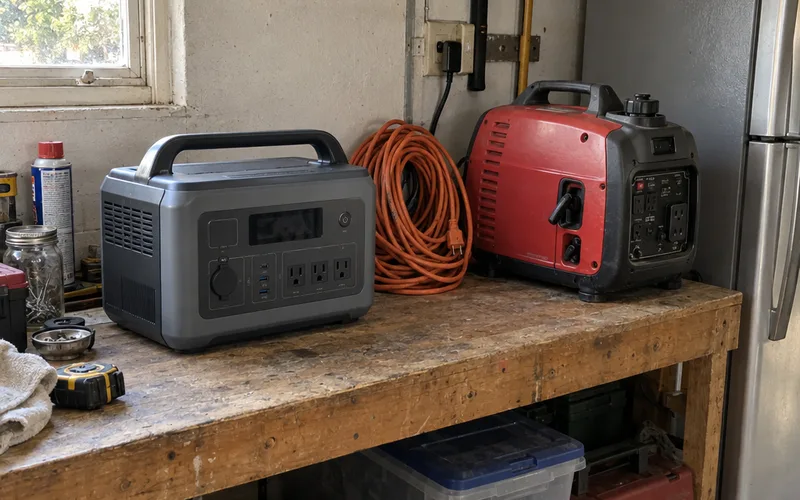
In other words, size a power station by its running watts, like a gas generator.
What Happens When Starting Watts Exceed the Generator’s Rating
When an appliance’s starting watts exceed what a generator can supply, the motor stalls or never starts. The generator bogs down, and its breaker can trip.
The fix is usually timing, not a bigger generator:
- Start the biggest motor first, with nothing else running. In the worked example, that keeps the fridge’s 1,500 extra watts from landing on top of the washer’s 1,100.
- Let it settle before you switch on the next one.
- Keep heaters off until the motors are running.
Generator load management can hold big loads off for you automatically.
How to Find Your Appliance’s Starting Watts
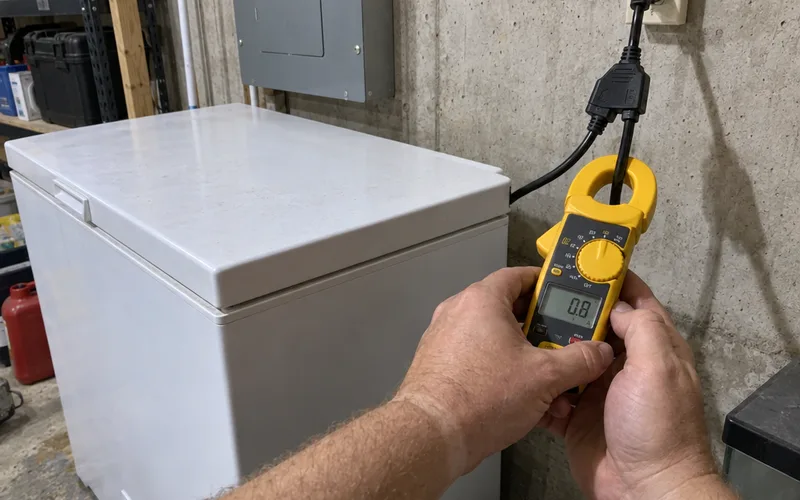
You can find an appliance’s starting watts on its nameplate or data plate, in its manual, or with a clamp meter. Running watts are usually on the label, or you can multiply volts by amps.
- Volts x amps: a hypothetical 120-volt, 5-amp appliance runs at 600 watts.
- LRA: locked rotor amps is the current a motor pulls the instant it starts. Times volts, it gives a rough, high-side starting figure.
- Clamp meter: one with an inrush setting reads start-up amps directly.
Use your own appliance’s numbers when you can, and treat any chart as an estimate.
Size for Both Numbers Before You Buy
The biggest mistake is matching your loads to only one rating.
Write down your running total and your peak this week, then take both into the full generator sizing process.
Frequently Asked Questions
What does 4500 starting watts mean?
A generator rated at 4,500 starting watts can deliver up to 4,500 watts for a few seconds to start a motor. Its lower running watts tell you what it can power continuously.
Will 8000 running watts run a house?
An 8,000-running-watt generator runs a house only if everything on at once adds up to less than 8,000 watts and the biggest motor surge fits under its starting rating. One electric dryer takes 5,400 of those watts on EcoFlow’s chart.
Do higher watts use more electricity?
An appliance with a higher running wattage uses more electricity each hour it runs, because watts measure how fast it uses power. A generator’s higher rating is only a ceiling, and your appliances still draw just what they need.